Showing posts with label Agra. Show all posts

Tuesday, 2 February 2016

Agra part 3 - an unexpected gem

On our second day in Agra we were supposed to get up early to see the Taj Mahal at sunrise, but as it was very misty our guide suggested we should visit the Tomb of I'timād-ud-Daulah, sometimes known as the Baby Taj. This was built in the 1620s as a mausoleum for the grandfather of Mumtaz Mahal (for whom the Taj Mahal was built) who was a minister of state.


It's important because it was the first example of the use of white marble in Mughal architecture, but it is much more than that. The gatehouse is giving little away about what is inside . . .


As we arrived early we were the only ones there at first. 


This gem is encrusted with pattern - 


cut and inlaid stone on the outside 


and paintings on the inside


Opposite the mausoleum itself is a smaller red sandstone building with painted decorations depicting perfume bottles - a Persian design. Again you can see the Mughal love of symmetry.


It is surrounded by extensive gardens and water gardens which are being renovated - these workers had just carried that rickety bamboo tower into place to work on the walls 


this woman was a gardener, collecting stones in her basket.


Whole flocks of mynah birds, parrots and eagles seemed to be enjoying the peace (and the food provided by the garden workers) but only this one posed for his picture.


The whole thing sits on the other side of the river from Agra itself.


After this unexpected delight we made a last visit to the Taj, this time by the West gate, to be greeted by camels (or rather ignored by camels). Agra is in Uttar Pradesh, but Rajasthan and the Thar desert is not far.


Also this rather posh bike shed


Time for a bit of people watching 


and one last photo of the Taj Mahal, 


before we drive on towards Jaipur.


Monday, 1 February 2016

Agra part 2: Crafts and the Red Fort.

The next stop in Agra were some craft collective workshops, where we could see a demonstration of precious stone inlay work and embroidered textiles (just before the hard sell!). Hard white marble from the hills near Ajmer is inlaid with lapis lazuli, carborundum, mother of pearl, jasper, agate, malachite, black onyx and turquoise.


The stones are cut finely and the marble incised to take the shapes using just these two tools. The red colour is a temporary coating which allows the design to be seen. Finally the design is laid out and cemented in place piece by piece and the piece is polished smooth.

In the textile emporium this man was doing very fine silk embroidery with couched gold-work on velvet. Their speciality was incorporating jewels into the work, each of which had a particular meaning.


Then after a buffet lunch at the Pinch of Spice (where we had to leave our arms and ammunition outside according to the brass sign) 


was the Red Fort. Our guide had timed our visit so that the afternoon light enhanced the red sandstone walls. 


The gates were huge to allow elephants with their mahouts through - 


the outside ones complete with drawbridge and moat, every bit as interesting as the carved walls - look at the delicate zigzags on the iron bar ...


and inside it seemed that every inch of the walls and ceilings had been intricately carved or painted.


Tiled and painted panels about to be restored just inside the gate.


Within the walls were various individual palces used as rooms for living, two mosques and public audience halls. This one is Diwan-i-Aam (wonder if that's where a certain producer got the idea for his name from?)


These pillars are decorated with typical Hindu carvings of lotus flowers and elephants - lucky because their trunks are raised


More elephant trunks for good luck- this time holding up the roof


This was the Khas Mahal (Marble Pavillon) used as a bedroom  - curtains could be hung from the arches to keep it warm in winter or shaded in summer 


The inside was highly decorated with pattern and flowers in gold and blue paint - only traces still remain to glint in the sunlight


This was a bookcase , high up on the wall


And the well


Balconies so that women could view proceedings below without being seen themselves


A cool summer house


And rhe sun beginning to set behind the rooftops


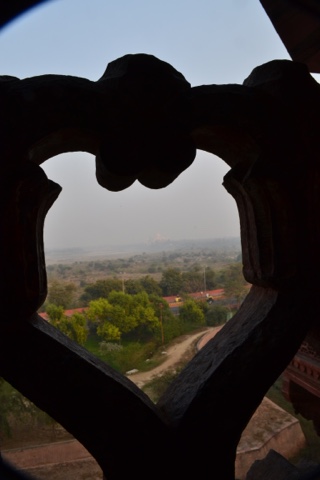
The Red Fort was built by the Mughal Emperor Akbar in the 1560s and was added to by his grandson Emperor Shah Jehan to make it a palace, and from here he could see across the valley to the Taj Mahal where his third wife was ultimately buried.


As always the building wasn't the only thing to see - colourful saris and salwar chemise on visitors:


and workers: 


Various wildlife


And another huge gate


So that was the end of our day - just a drive through Agra's busy traffic back to our hotel for dinner and a rest - so tired we opted for room service dinner: vegetable biryani with dal and naan, washed down with ginger ale! Very nice it was too!